Showing posts with label Switchgear and Protection. Show all posts

Wednesday, 20 July 2016

Circuit Breaker Maintenance

Some ratings for knowledge:
Spring charge motor   DC 220 V


Coils  : Shunt Trip  110 V Dc
                Closing Coil   110 V Dc


There are three types of maintenance:
Corrective, Preventive and Predictive.

The governing IS for CBs:

  • Routine test as per IEC 60065/IS 13118
  • Testing alongwith panels to be tested as per IEC 60298/ IS 3427


Shown above is a 12 KV VCB, 1600 A, 25 kA

Interrupter Assembly:

  • contacts
  • arc interrupters
  • arc chutes
Operating assembly
Operating rod
control panel
sealing system

Breaking Medium
  • SF6
  • Oil
  • Vacuum and Air 


Auxiliary Equipment  :   Alarm Scheme, Annunciator etc\

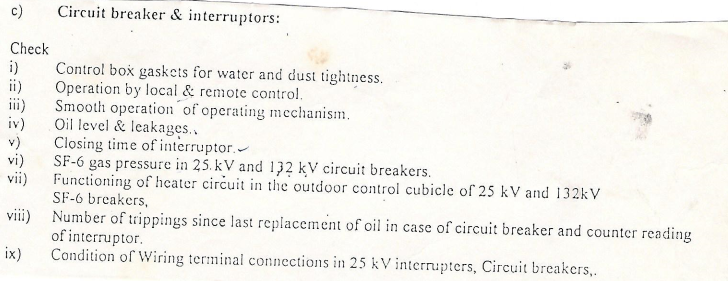
What checks we should carry out in a traction substation regarding CB and interruptor?
Thursday, 18 June 2015

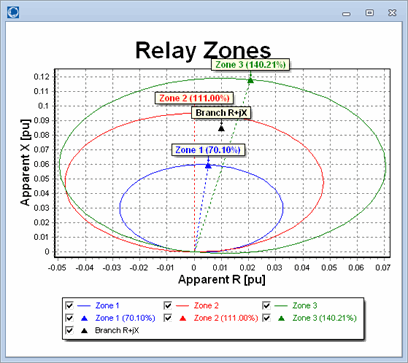
Distance Relays

Reactance relays cant be made directional. A directional element cant be added to them since these relays operate under normal load condition and U.PF.

Reactance relays are used for ground faults because a ground fault relay should be independent of ground fault resisntance. ( which is variable).

Used for < 10 miles ( Short T.L.).

Mho relay or admittance relays ( for 50 miles +) is used for phase fault condition.

Arc resistance affects an impedance relay more than a reactance relay but less than Mho relay.

Wednesday, 31 October 2012

Grounding

Advantages of neutral grounding:

  • Voltage of phases are limited to phase to ground voltage.
  • High voltages due to arcing grounds or transient line-ground faults are eliminated.
  • Sensitive protective relays against LG faults can be used.
  • Overvoltages due to lightening are discharged to ground.
Advantages of isolated neutral

  • It is possible to maintain supply with fault on line.
  • Interference with communication lines is reduced because of no Z sequence current.
Effective grounding systems:

X0 / X1 < 3

Least Expensive is = maxm Vphase= 0.8 V line


Tuesday, 14 February 2012

Some facts on protection


HRC fuse breaking capacity:- 80 KA
SF6 breaking capacity:- 30 KA
ACB breaking capacity :- 50 KA

hence fuses are used for S.C. protection and Relays for O.L. protection.

T1 and T2 reduce the fault current ( say from 400 A to 10 A ) which is the utility of these transformers.


Protections used in 132 KV/ 6.9 KV switchyard:-
  • Lightening arrestor 120 KV, 10 KA

  • IDMT O/C Relay + IDMT E/F Relay ( 51 + 51 N)
  • IDMT O/C Relay + Instantaneous Relay + IDMT E/F Relay ( 51 + 50 + 51 N)
  • Transformer Differential Relay(87)
  • Restricted E/F Relay + Standby E/F Relay (64 R + 51 G)

Some notes on SubStation Relays

Trip Circuit Supervision Relay ( VAX ) :- 21 ( After closing only) 31 ( Preclosing and After Closing).
Application :- After Cl;osing or continuous supervision of the trip circuit or circuit breaker.
Detection:-
1.Failure of Trip Supply
2.Open Circuit of trip Coil or trip circuit wiring
3.Failure of mechanism to complete the tripping operation.

A CTZM Relay is used at ACB in PCC which feeds the MCC and the delay settins are provided there at.

When 10 MVA primary side SF6 primary side SF6 breaker operates, there should be an interlock to open the breaker on secondary side ( to prevent closing on load T/F) but this is not provided and is done manually.

CBCT :- Core Balance Current Transformer, Used for Unbalanced Current Protection.