Thursday, 18 June 2015

Distance Relays

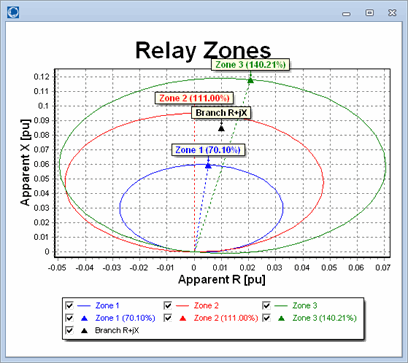
Reactance relays cant be made directional. A directional element cant be added to them since these relays operate under normal load condition and U.PF.

Reactance relays are used for ground faults because a ground fault relay should be independent of ground fault resisntance. ( which is variable).

Used for < 10 miles ( Short T.L.).

Mho relay or admittance relays ( for 50 miles +) is used for phase fault condition.

Arc resistance affects an impedance relay more than a reactance relay but less than Mho relay.

Bundled conductors

Advantages:-

  • Reduced reactance.( L is reduced)
  • Reduced voltage gradient. 
  • Reduced corona losses.
  • Reduced Radio intrerference.
  • Reduced surge impedance.
  • Oncreased capacity of transission.

Thursday, 14 May 2015

Buildings Fire safety

IS 1646- 1982:

This IS covers following points: 

General Requirements

Power Equipment

Switchboards

Power Distribution and Motor Control Gear

Transformer Substation, Excluding Bell and Drawing Frame, Transformer and Transformers of Small Capacity

Earth Conections

Wiring Methods

Permitted Types of Wiring Methods

Lighting, Fittings and Accesories

Special Electrical Equipment and Appliances

Requirements For special Occupancies

General Godowns

Testing

Inspection


Symbols and connection diagrams of circuits


Wednesday, 8 January 2014

Some notes on HVDC

Advantage of ground retuyrn:


  • Earth resistance in case of dc for long lines is interdependent of length and this resistance is < that of metallic conductor if used.
  • d.c line can be built in two stages.
  • reliability increases in case of outage one monopolar out of the bipolar.


Disadvantages of  ground return:

  • Electrolytic erosion of buried / immersed metallic structure.
  • difficult design
  • Ground currents can cause dangerous step and touch voltages.
  • Ground current interferes with other services.

Saturday, 22 December 2012

Ohm's Law and kirchoff's law


Ohms law:
•v(t) = i(t) R  - or -  V = I R
•p(t) = i2(t) R = v2(t)/R  [+ (absorbing)]
Kirchoffs law:

•Kirchhoff’s Current Law (KCL)

–sum of all currents entering a node is zero

–sum of currents entering node is equal to sum of currents leaving node


•Kirchhoff’s Voltage Law (KVL)
–sum of voltages around any loop in a circuit is zero
Kirchoffs Current Law :

The sum of currents entering the node is zero:

Analogy: mass flow at pipe junction


KVL Polarity
•A loop is any closed path through a circuit in which no node is encountered more than once
•Voltage Polarity Convention
–A voltage encountered + to - is positive
–A voltage encountered - to + is negative


Electrical Analogies (Physical)


Thursday, 20 December 2012

Basic Electrical Quantities


•Basic quantities: current, voltage and power
–Current: time rate of change of electric charge
  I = dq/dt 
1 Amp = 1 Coulomb/sec
–Voltage:  electromotive force or potential, V 
1 Volt = 1 Joule/Coulomb = 1 N·m/coulomb
–Power:  P = I V 
1 Watt = 1 Volt·Amp = 1 Joule/sec

•Active elements can generate energy
–Batteries
–Voltage and current sources
•Passive elements cannot generate energy
–Resistors
–Capacitors and Inductors (but CAN store energy)
An independent source (voltage or current) may be DC (constant) or time-varying, but does not depend on other voltages or currents in the circuit.
The dependent source magnitude is a function of another voltage or current in the circuit.


Monday, 26 November 2012

A motor problem

Q) A 25 HP 6 Pole 50 Hz 3 phase 960 rpm at full load. I 2 = 35 A, Allowing 250 W as Cu loss in SC gear . 1000 W = Mech losses.
How much is r2?
Ans)

Q) 440 V , 50 Hz, 6P, 3 phase, 

Ans) F2 = 100/60 


Monday, 5 November 2012

RL circuit on a AC source.

In the previous post we had seen RL circuit on DC source. Now lets see it on AC source


Transients in power system

Transients in simple circuit

DC Sources:


  • Resistance only
  • Inductance only
  • Capacitance only

  • RC Circuit

  • RLC Circuit:


Sunday, 4 November 2012

How to control voltage in power system


We have seen total grid collapsing twice recently. How voltage is controlled? Lets see in the above diagram


Sources and sink of Reactive power


  • Transmission line
  • Cables
  • Synch. Machines
  • Shunt capacitors and reactors
  • Series capacitors

Wednesday, 31 October 2012

Insulated Cables


Capacitance of three core cables


Grounding

Advantages of neutral grounding:

  • Voltage of phases are limited to phase to ground voltage.
  • High voltages due to arcing grounds or transient line-ground faults are eliminated.
  • Sensitive protective relays against LG faults can be used.
  • Overvoltages due to lightening are discharged to ground.
Advantages of isolated neutral

  • It is possible to maintain supply with fault on line.
  • Interference with communication lines is reduced because of no Z sequence current.
Effective grounding systems:

X0 / X1 < 3

Least Expensive is = maxm Vphase= 0.8 V line


Tuesday, 30 October 2012

Series or Shunt Capacitor

Voltage Boost:

Shunt Capacitor: Evenly distributed over transmission line.

Series Capacitor: -----------------------I  I-------------------------
                                                   V1            V2
                                     Sudden change of voltage


  • Shunt Capacitor improves power factor of the load whereas Series capacitor has little effect on pf.
  • For long transmission line, where total reactance is high, series capacitors are effective for improvement of system stability.


Monday, 10 September 2012

How to measure Flow?

Flow Strainers, Impellers, Magnetic sensing pickups. 

Turbine Meter

  • good for telemetry
  • errors may be caused 'coz of excessive frictional torque.
Electromagnetic flowmeter
  • suitable for slurry, sludges etc
  • Adv: size adaptability,No pressure drop
  • Disad: for heavy slurry, high operating cost.
Hot Wire Anemometers

  • more flow > more cooling
  • voltage variation
  • measured by POT

Using Thermister

  • can measure velocity of air

Ultrasonic flow meter

  • used mainly for liquid
  • useful for bidec tional flow
  • Adv:linear relationship
  • Adv:insensitive to variation in viscocity, density and temp
  • Disadv: complexity
  • Disadv: relative high cost