Electrical Engineering is God's Engineering. You cant see electricity, you cant see God. Electricity dispels darkness. So lets try exploring this divine engineering through this blog..... Find me on facebook with indiwindy@gmail.com
Monday, 25 July 2016
Wednesday, 20 July 2016
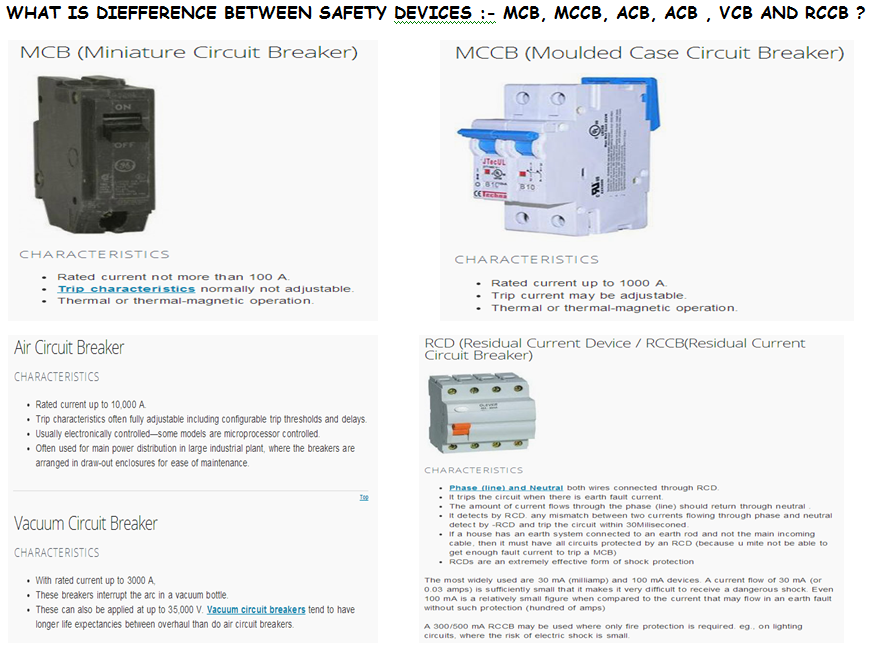
More on Circuit Breakers
Some common problems encountered in CBs:
Make Problem
ALIND................................. Chain
CGL interruptor.....................Tripping latch lever
Energoinvest int....................Blocking lever and Coupling
Merlin German Inturrptor......C & D Rollers.
Now lets see some test reports of 25 KV single pole VCB:
Make Problem
ALIND................................. Chain
CGL interruptor.....................Tripping latch lever
Energoinvest int....................Blocking lever and Coupling
Merlin German Inturrptor......C & D Rollers.
Now lets see some test reports of 25 KV single pole VCB:
Labels:
Circuit Breaker Maintenance
Some ratings for knowledge:
Spring charge motor DC 220 V
Coils : Shunt Trip 110 V Dc
Closing Coil 110 V Dc
Corrective, Preventive and Predictive.
The governing IS for CBs:
- Routine test as per IEC 60065/IS 13118
- Testing alongwith panels to be tested as per IEC 60298/ IS 3427
Shown above is a 12 KV VCB, 1600 A, 25 kA
Interrupter Assembly:
- contacts
- arc interrupters
- arc chutes
Operating assembly
Operating rod
control panel
sealing system
Breaking Medium
- SF6
- Oil
- Vacuum and Air
Auxiliary Equipment : Alarm Scheme, Annunciator etc\
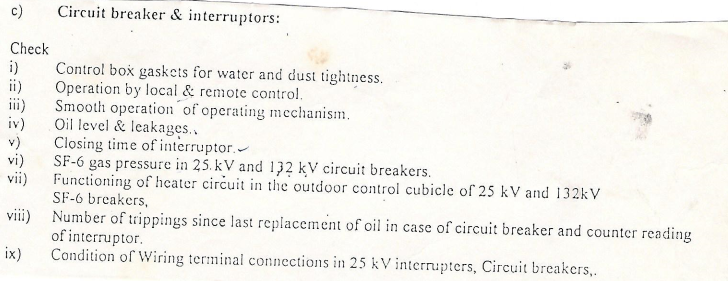
What checks we should carry out in a traction substation regarding CB and interruptor?
Friday, 8 July 2016
Earthing
I.E. Rules 61 : substation and equipments
I.E. Rules 67 : HV and EHV
Maxm Res. :
Large power stations 0.5 ohms
Major Substations 1.0 ohms
Small Substations 2.0 ohms
Others 8 ohms
I.E. Rules 1956 Chapter I
Low : 250 V
Medium: 650 V
HV: 11 KV
EHV: 33 KV
I.E. Rules 67 : HV and EHV
Maxm Res. :
Large power stations 0.5 ohms
Major Substations 1.0 ohms
Small Substations 2.0 ohms
Others 8 ohms
I.E. Rules 1956 Chapter I
Low : 250 V
Medium: 650 V
HV: 11 KV
EHV: 33 KV
Labels:
Earthing and Grounding
A note about slip test
It is conducted to calculate unsaturated Xd and Xq.
We feed subnormal voltage to armature, mechanically rotate it, keep field open ( Vf)
Here Nr is not equal to Ns.
but is almost equal to Ns.
Since mmf due to armature reaction is rotating at Ns, field poles gradually slip w.r.t. rotating armature mmf.
Thus R = 1/ u of path of mmf changes at twice slip freq. from maxm when axis of poles and axis of armature reaction wave coincide and minm. when they are at right angles.
We feed subnormal voltage to armature, mechanically rotate it, keep field open ( Vf)
Here Nr is not equal to Ns.
but is almost equal to Ns.
Since mmf due to armature reaction is rotating at Ns, field poles gradually slip w.r.t. rotating armature mmf.
Thus R = 1/ u of path of mmf changes at twice slip freq. from maxm when axis of poles and axis of armature reaction wave coincide and minm. when they are at right angles.
Labels:
Motors
MCQs on Electrical Engineering
Q. The phase sequence of alternator wil reverse when
- I(f) is reversed, keeping direction of rotation as same.
- I(f) remains same, direction of rotation is reversed.
- I(f) reversed, P x2
- P x 2 , I(f) same
Labels:
MCQs
More about Transformers
The weakest link in the transformer is Cellulose !
Condition of Cellulose depends upon Moisture, Temp and Oxygen.
Due top weak Cellulose, Partial Discharge and creepage failures occur.
There is something called piper chart (H2O in paper Vs H2O in oil)
water in paper increases parabolically with water increase in oil.
Oil Paper
New T/F 1 1000
Old T/F 1 500
A typical 220 KVA T/F will have 56 T oil and 6 T paper.
Condition of Cellulose depends upon Moisture, Temp and Oxygen.
Due top weak Cellulose, Partial Discharge and creepage failures occur.
There is something called piper chart (H2O in paper Vs H2O in oil)
water in paper increases parabolically with water increase in oil.
Oil Paper
New T/F 1 1000
Old T/F 1 500
A typical 220 KVA T/F will have 56 T oil and 6 T paper.
Labels:
Transformers
Thursday, 18 June 2015
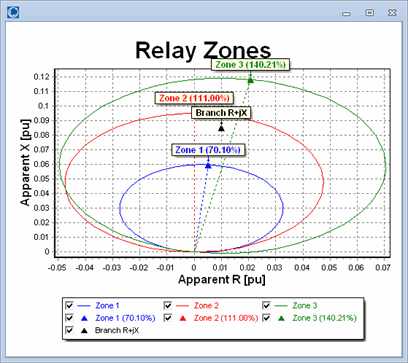
Distance Relays
Reactance relays cant be made directional. A directional element cant be added to them since these relays operate under normal load condition and U.PF.
Reactance relays are used for ground faults because a ground fault relay should be independent of ground fault resisntance. ( which is variable).
Used for < 10 miles ( Short T.L.).
Mho relay or admittance relays ( for 50 miles +) is used for phase fault condition.
Arc resistance affects an impedance relay more than a reactance relay but less than Mho relay.
Reactance relays are used for ground faults because a ground fault relay should be independent of ground fault resisntance. ( which is variable).
Used for < 10 miles ( Short T.L.).
Mho relay or admittance relays ( for 50 miles +) is used for phase fault condition.
Arc resistance affects an impedance relay more than a reactance relay but less than Mho relay.
Labels:
Switchgear and Protection
Thursday, 14 May 2015
Buildings Fire safety
IS 1646- 1982:
This IS covers following points:
General Requirements
Power Equipment
Switchboards
Power Distribution and Motor Control Gear
Transformer Substation, Excluding Bell and Drawing Frame, Transformer and Transformers of Small Capacity
Earth Conections
Wiring Methods
Permitted Types of Wiring Methods
Lighting, Fittings and Accesories
Special Electrical Equipment and Appliances
Requirements For special Occupancies
General Godowns
Testing
Inspection
This IS covers following points:
General Requirements
Power Equipment
Switchboards
Power Distribution and Motor Control Gear
Transformer Substation, Excluding Bell and Drawing Frame, Transformer and Transformers of Small Capacity
Earth Conections
Wiring Methods
Permitted Types of Wiring Methods
Lighting, Fittings and Accesories
Special Electrical Equipment and Appliances
Requirements For special Occupancies
General Godowns
Testing
Inspection
Labels:
Safety
Thursday, 16 April 2015
Tuesday, 14 April 2015
Thursday, 7 August 2014
Wednesday, 8 January 2014
Some notes on HVDC
Advantage of ground retuyrn:
Disadvantages of ground return:
- Earth resistance in case of dc for long lines is interdependent of length and this resistance is < that of metallic conductor if used.
- d.c line can be built in two stages.
- reliability increases in case of outage one monopolar out of the bipolar.
Disadvantages of ground return:
- Electrolytic erosion of buried / immersed metallic structure.
- difficult design
- Ground currents can cause dangerous step and touch voltages.
- Ground current interferes with other services.
Labels:
HVDC
Wednesday, 18 December 2013
Subscribe to:
Posts (Atom)


.jpg)
.jpg)
.jpg)
.jpg)
.jpg)
.jpg)
.jpg)
.jpg)
.jpg)